
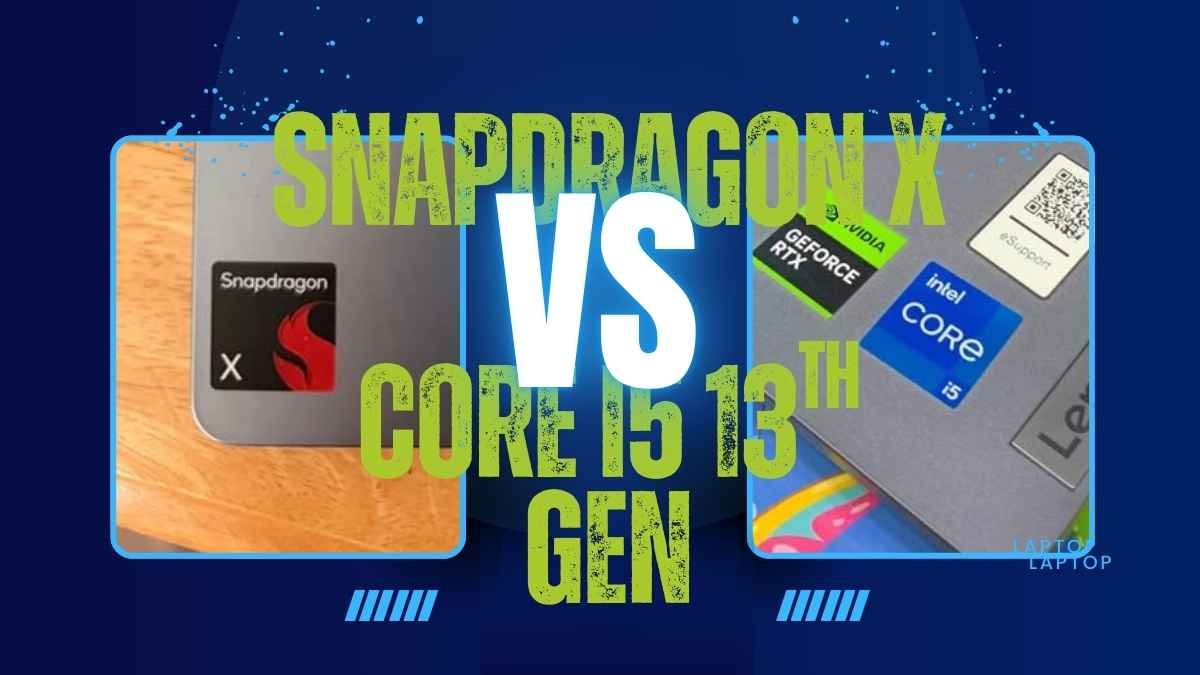
| Spec | Intel Core i5-1335U | Snapdragon X (X1-26-100) |
|---|---|---|
| Architecture | x86 (13th Gen “Raptor Lake-U”) | ARM (Qualcomm Oryon) |
| Process node | Intel 7 (10nm) | TSMC 4nm |
| Cores / Threads | 10 / 12 (2P + 8E) | 8 / 8 (Oryon) |
| Base clock | 1.30 GHz | 2.96 GHz |
| Max clock | Up to 4.6 GHz (2.42 GHz observed) | Up to 3.0 GHz |
| Observed clock | 2.42 GHz @ 16% load | 1.05 GHz @ 3% load |
| L1 cache | 928 KB | 2.2 MB |
| L2 cache | 6.5 MB | 24 MB |
| L3 cache | 12 MB | None (large shared L2) |
| Graphics | Intel Iris Xe | Qualcomm Adreno X1-45 |
| GPU driver | 32.0.101.7077 | 31.0.85.0 |
| NPU (AI) | None | Qualcomm Hexagon, ~45 TOPS |
| DirectX | 12 (FL 12.1) | 12 (FL 12.1) |
| Memory (tested unit) | 16 GB | 16 GB |
| Storage (tested unit) | NVMe SSD | NVMe SSD |
| Base TDP | 15 W | ~15–23 W class |
| Processor Types Available | Intel Core i5-13420H, Intel Core i5-1334U, Intel Core i5-1335U | Snapdragon X X1-26-100, Snapdragon X Plus (10 Core) |
The Verdict
Snapdragon X and Intel i5 13 th Gen are two radically different ways of doing laptop computing. Snapdragon X has established itself as the future of windows laptops with a focus on AI, unparalleled battery life, and ARM-based performance. The 13th-generation i5 processors by Intel are the successors of the x86 architecture, which have established compatibility, high multi-threading, and extensive software compatibility.
Snapdragon X laptops are built on the Copilot+ PC experience, with up to 45 TOPS of NPU performance on AI-accelerated workloads. They focus on ultrabooks that are lightweight and have high-quality displays and exceptionally long battery life, usually over 13 hours and up to 34 hours on some models.
Intel i5 13 th generation laptops are the laptops that are attractive to users who value software compatibility and value. They have a wider price range that includes prices as low as 52,990, which is affordable to low-end customers. Their architecture is hybrid to integrate performance and efficiency cores to multitask.
Snapdragon X has a smaller variety of configurations, and all the tested models have 16 GB RAM and begin at 54,990. Intel i5 laptops come with 16GB to 24GB RAM, and storage capacity of 256GB to 1TB, which offers greater flexibility to various budgets and requirements.
Although the two platforms offer equally good productivity performance, they are designed with totally different purposes; Snapdragon X is the best in battery efficiency and AI performance, whereas Intel i5 13 th Gen offers the best value and software compatibility. Snapdragon X has a mean score of 8.45 in performance against the 7.82 of Intel. In case next-generation AI capabilities and long-day battery life are in the spotlight, Snapdragon X will be the more suitable choice, whereas Intel i5 will be the less risky option in case of conventional software processes.
Which Laptop Should You Buy?
The laptops that have won the award of the best overall in each platform have the best overall performance. The total performance is calculated based on the score of 8 different categories such as battery life, display quality, portability, build quality, performance benchmarks, AI capabilities, connectivity, and value.
Other factors considered include weight and thermal performance, which are not scored directly.
The two best suggestions between Snapdragon X and Intel i5 13th Gen are Microsoft Surface Laptop 7th Edition and Lenovo IdeaPad Slim 3.
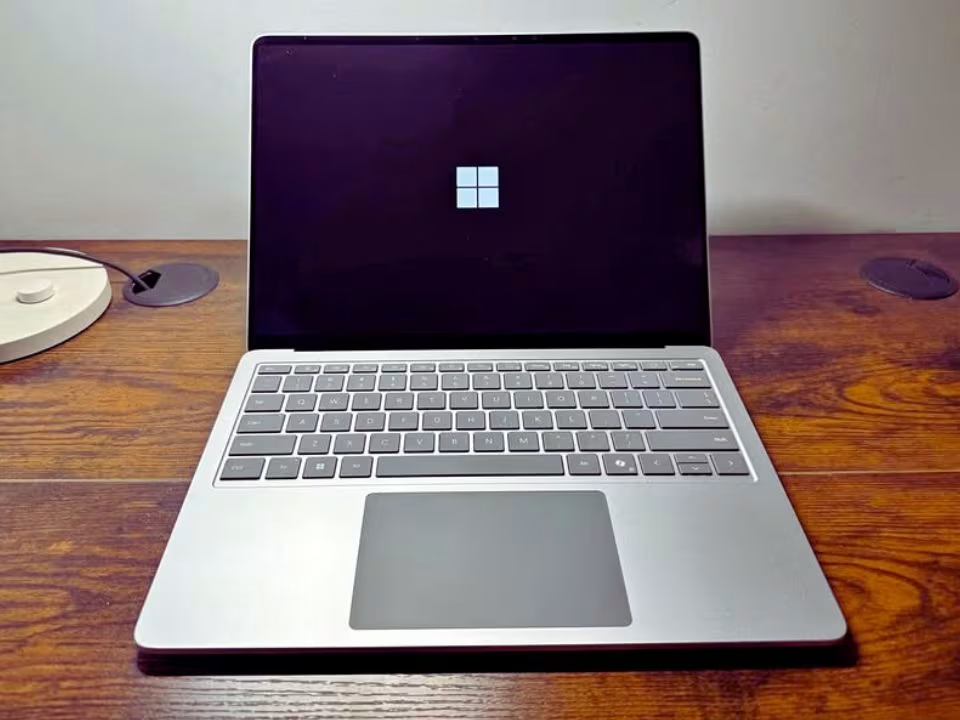
Microsoft Surface Laptop 7th Edition is a 13.8-inch ultrabook that runs on the Snapdragon X Plus (10 Core) processor and has 16 GB of LPDDR5x RAM and 256 GB of SSD. It is of high quality construction and has a beautiful PixelSense touchscreen display of 2304 x 1536 resolution. It provides an impressive battery life of up to 13 hours and an excellent AI performance of 45 TOPS. The display quality of this laptop is brilliant, it is ultra lightweight with a weight of only 1.22 kg and it is productive. This laptop is the best choice among professionals and creative users who want to use the latest AI features and have a premium design and Copilot+ PC features.
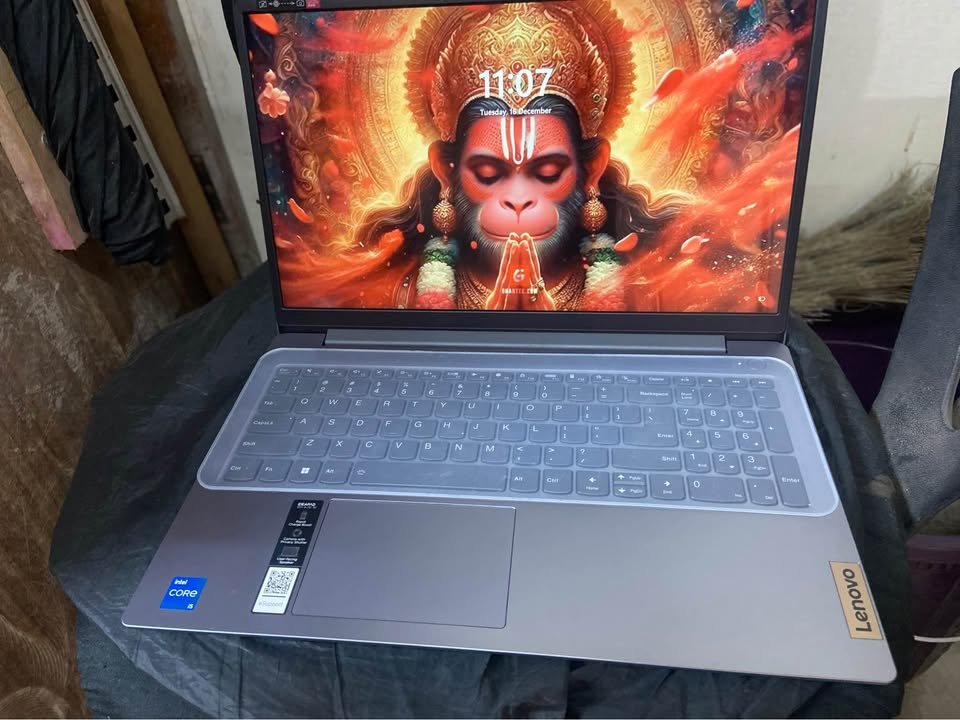
Lenovo IdeaPad Slim 3 is a 15.3-inch laptop that has Intel Core i5-13420H processor, 24 GB DDR5 RAM, and 1 TB SSD. It is designed in a practical way and has a WUXGA IPS anti-glare display of 1920 x 1200 resolution. The IdeaPad Slim 3 is a great value product with high memory and storage options in its prices. The laptop is well built with MIL-STD-810H certification, has a battery life of up to 14.5 hours and is also provided with one year of accidental damage coverage. Its moderate specification and strong build make this laptop comfortable to those users who want reliability and productivity at a reasonable cost.
The Microsoft Surface Laptop 7th Edition and Lenovo IdeaPad Slim 3 are the best laptops of each platform, but there is a significant difference between the two laptops.
Microsoft Surface Laptop is an ARM-based ultrabook, whereas the Lenovo IdeaPad Slim 3 is a conventional x86 productivity laptop. Microsoft also produces a more overall performance and is also much higher in price tag.
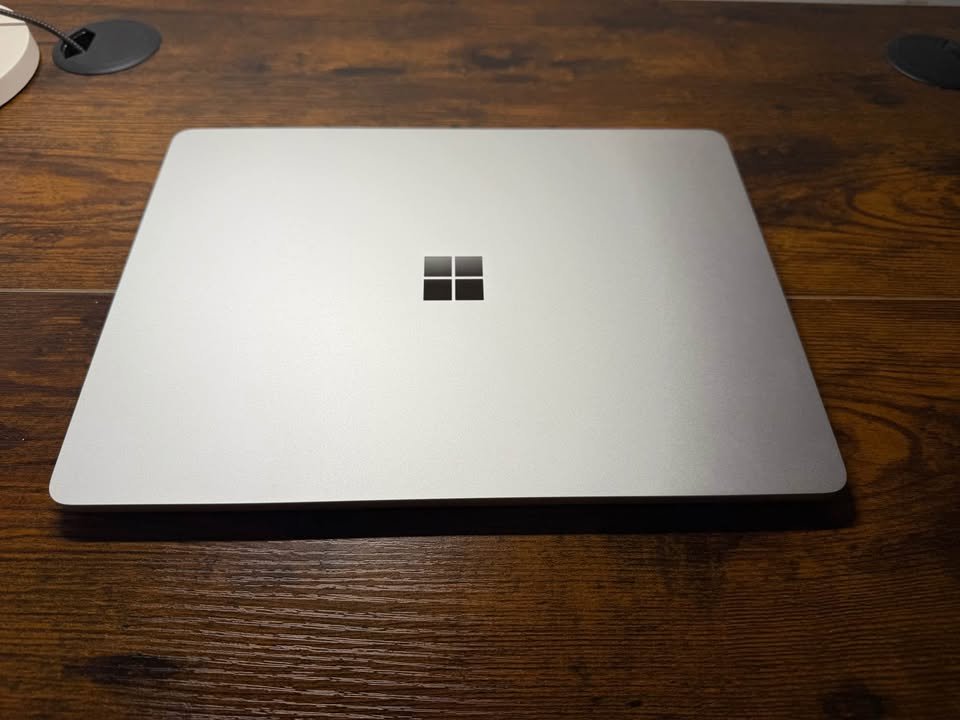
In terms of the feel of the laptop, the Surface Laptop is made of high-end aluminum, weighs 1.22 kg, and has a glossy PixelSense touchscreen. The Microsoft Surface Laptop has a total performance score of 9.42, which is in the top 10 percent of all the tested laptops so far.
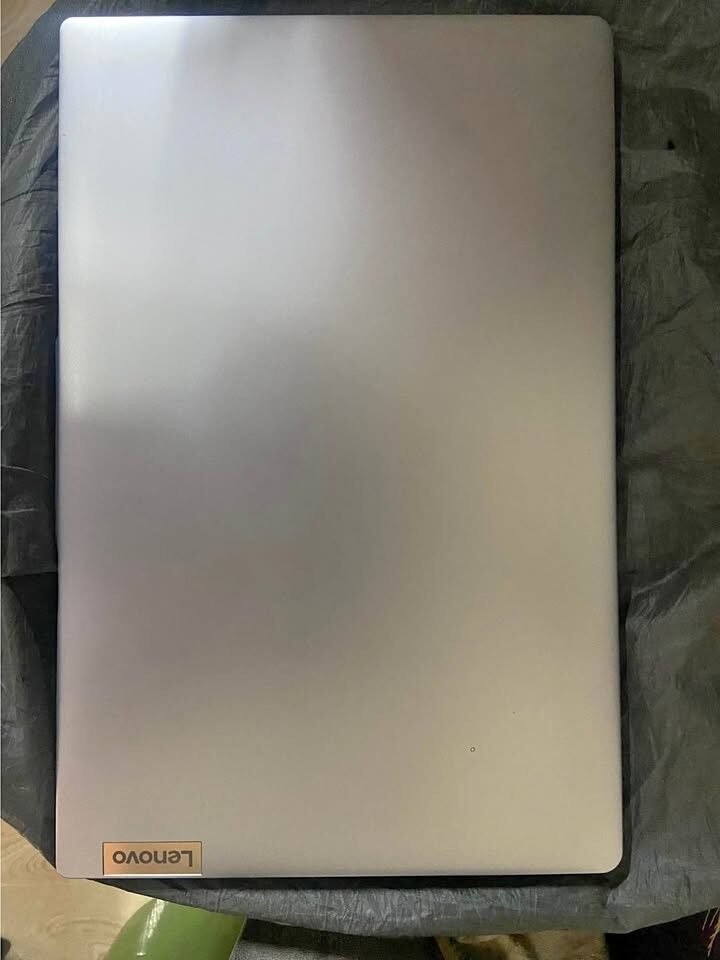
Conversely, there is the Lenovo IdeaPad Slim 3. The overall score of this laptop is 8.36 which is in the top 30 percent of all laptops which have been tested so far. It has a durable aluminum-topped construction, easy 1.59 kg weight, and 10/10 ratings on value, storage capacity, RAM setup, and durability of the build.
Performance alone will see the Microsoft Surface Laptop being the better laptop to the user who values AI functionalities and portability, but you can save approximately 60,000 and still have more RAM and storage with the Lenovo IdeaPad Slim 3.
Intel Core 5 120U vs Snapdragon X Plus
The Intel Core 5 120U and the Qualcomm Snapdragon X Plus (X1P42100) are both making for the same category of thin-and-light laptop, but the way they are reaching there is totally opposite — one is hybrid x86 efficiency type, another is ARM-based Oryon performance type.
| Specification | Intel Core 5 120U | Snapdragon X Plus X1P42100 |
|---|---|---|
| Architecture | Raptor Lake, 10 nm, x86-64 | Qualcomm Oryon, ARM64 |
| Cores / Threads | 10 (2P + 8E) / 12 | 8 / 8 |
| Base Clock | 1.40 GHz | 3.24 GHz |
| Observed Boost | 3.19 GHz | 3.24 GHz sustained |
| L2 / L3 Cache | 6.5 MB / 12 MB | 24 MB / — |
| Graphics | Intel UHD Graphics | Adreno X1-45 (128 MB) |
| NPU | None | Integrated Hexagon NPU |
| TDP | 15 W | ~15–20 W class |
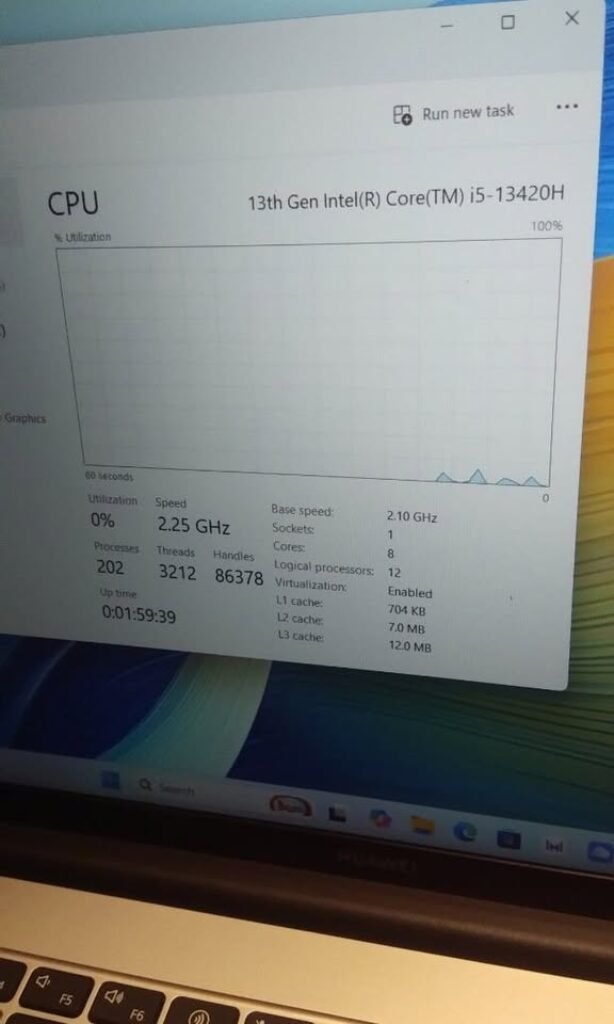
The most big difference you can see is in the base clock. The Core 5 120U is staying idle at 1.40 GHz and it is only touching 3.19 GHz when the load is coming, and in my Task Manager capture it was sitting on 2.76 GHz with 18% utilization while 210 processes are running in background. But the Snapdragon X Plus, it is running full 3.24 GHz base clock on all eight cores together — no efficiency-core throttling problem here — and still it was pulling only 0.74 GHz at 7% utilization in idle condition. This is meaning you get more snappy burst when apps are opening, and also less power draw when you are doing nothing.
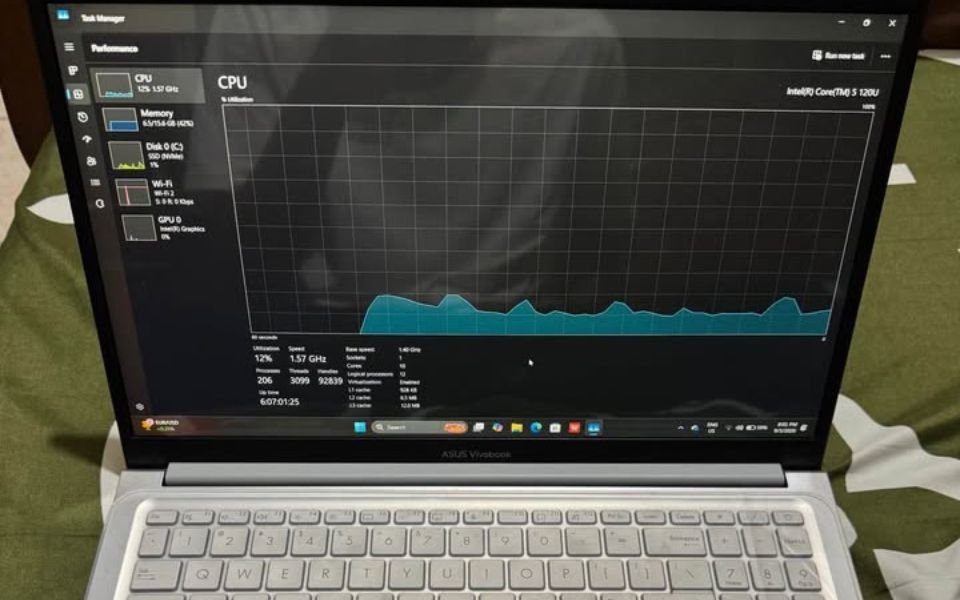
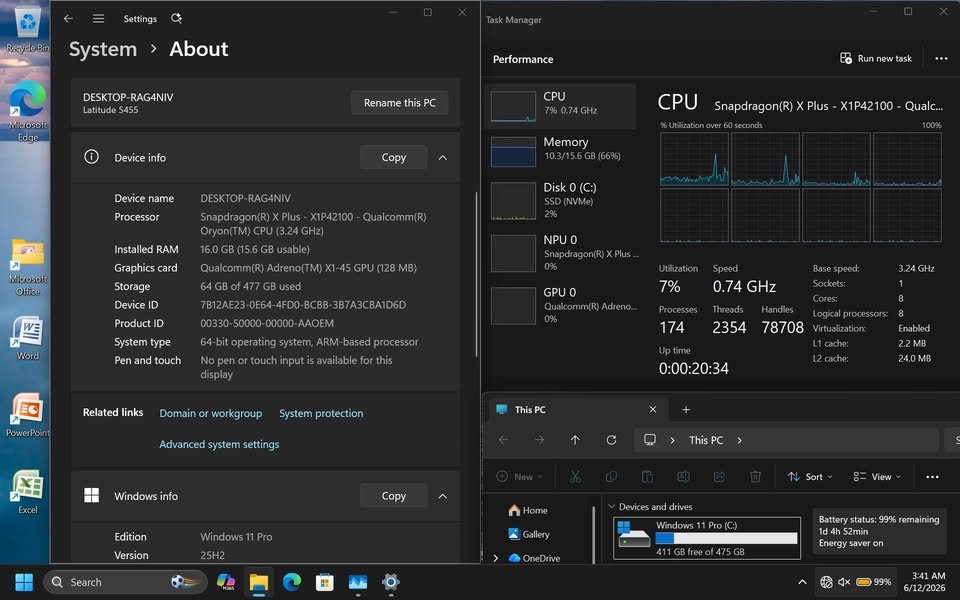
On the raw thread count Intel is the winner (12 against 8), because of its hybrid 2P + 8E arrangement, which is helping a lot in those background-heavy type of workloads. But Qualcomm is giving the answer back with one huge 24 MB L2 cache, compare to Intel only 6.5 MB — so the data is staying more near to the cores and the memory latency is becoming less in the sustained tasks.
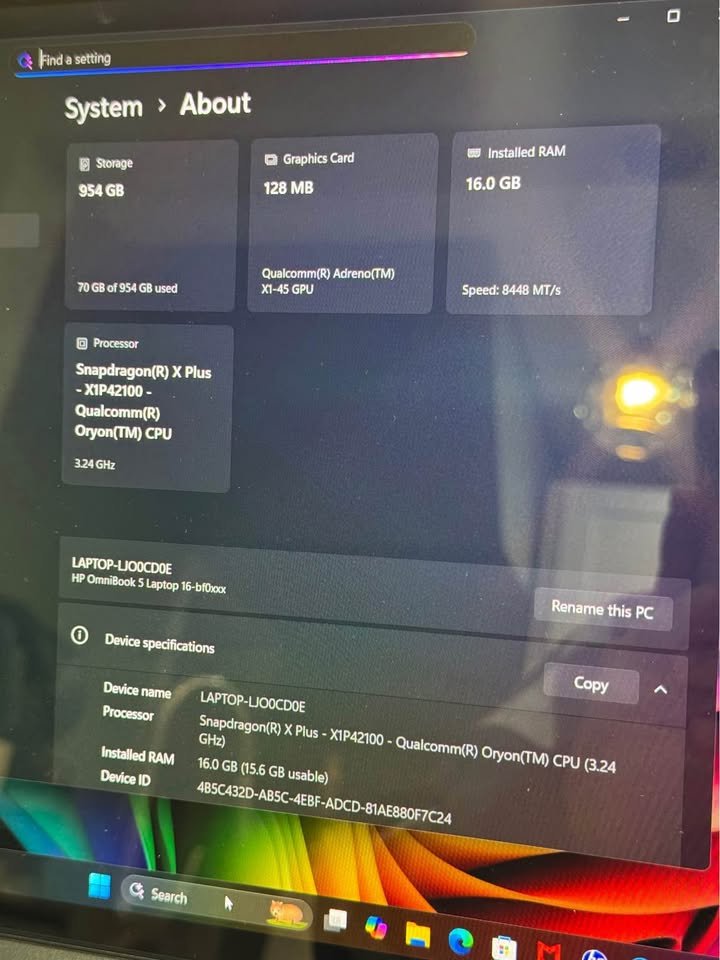
The Adreno X1-45 is comfortably going ahead of the Intel UHD Graphics inside the 120U, which is not even having Iris Xe. On top of that, the Snapdragon is also coming with one dedicated NPU for the Copilot+ AI features — this is a thing the Core 5 120U simply cannot do any match. And the battery life, this one is the real knockout punch — my Snapdragon test machine was reporting 1 day, 4 hours, 52 minutes still remaining at only 99% charge.
Best Laptop by Category
We shall honour some of the specific laptops before we get down to the gritty details. The laptops below excelled remarkably when each category was considered separately.
Compare the Laptops
The table below shows the overall performance score of every laptop we’ve tested from each platform. In total, 8 laptops were tested for this comparison.
8
Laptops Tested In Comparison
45
Data Points Tested On Each Laptop
6
In-Depth Laptop Analyses
After comparing 4 Snapdragon X laptops, the average performance score is 8.45. After comparing 4 Intel i5 13th Gen laptops, the average performance score is 7.82.
Between the two, Snapdragon X has a higher performance, but Intel i5 13th Gen has a lower average price. The average price for a Snapdragon X laptop is ₹1,03,740, and the average price for an Intel i5 13th Gen laptop is ₹62,480.
Moving on, let’s talk about specific performance categories. Depending on what factors are most important to you, individual laptops may rise above others. The table below looks at 10 testing categories and highlights the top-performing laptops in those particular tests.
Processor Specifications
Looking at all available laptops we’ve tested, Snapdragon X processors feature 8 to 10 cores with NPU performance up to 45 TOPS. Intel i5 13th Gen processors feature 8 to 10 cores with no dedicated NPU.
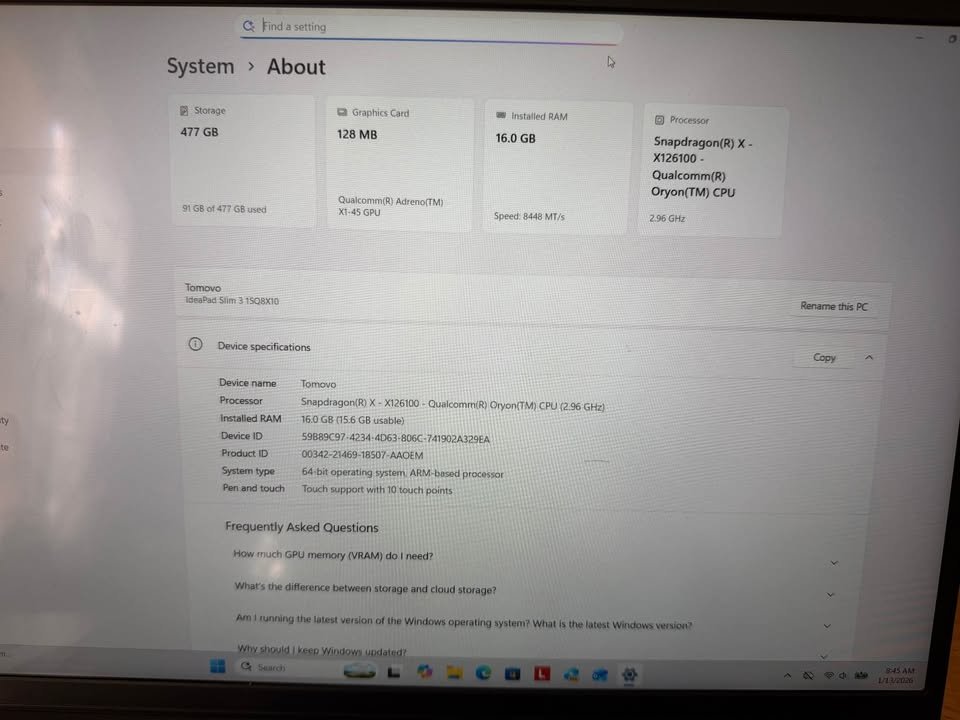
Of the two platforms, Snapdragon X has the clear advantage for AI workloads by a significant margin. If you’re looking for AI-accelerated features, especially, Snapdragon X will be the better option. The Snapdragon X Plus, in particular, offers 10 cores with exceptional power efficiency.
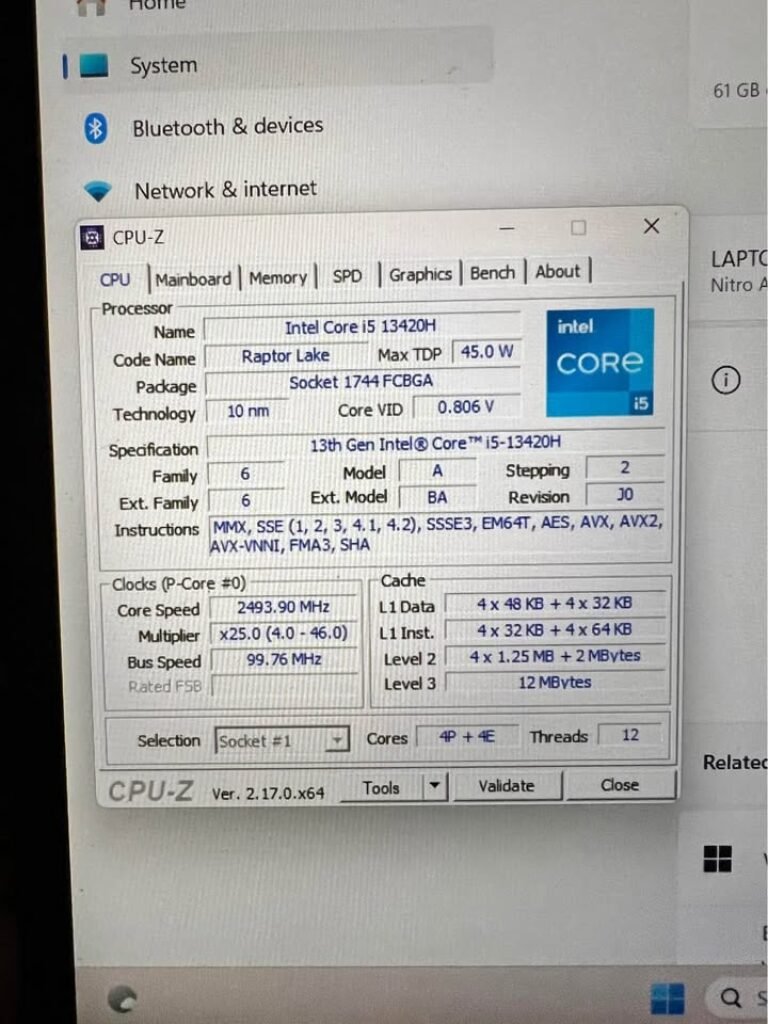
However, Intel’s 13th Gen i5 hybrid architecture, with performance and efficiency cores, will be suitable for the vast majority of traditional computing tasks.
Check the table below to see the details of each laptop.
| Laptop | Processor | Cores | Base Speed | Max Speed | NPU |
| ASUS Vivobook 16 | Snapdragon X X1-26-100 | 8 | 2.97 GHz | 2.97 GHz | 45 TOPS |
| Samsung Galaxy Book4 Edge | Snapdragon X X1-26-100 | 8 | 1 GHz | 3 GHz | 45 TOPS |
| Microsoft Surface Laptop 7th Edition | Snapdragon X Plus (10 Core) | 10 | 3.4 GHz | 3.4 GHz | 45 TOPS |
| HP OmniBook 5 OLED | Snapdragon X X1-26-100 | 8 | 3 GHz | 3 GHz | 45 TOPS |
| ASUS Vivobook 15 | Intel Core i5-13420H | 8 | 2.1 GHz | 4.6 GHz | None |
| HP 250 G10 | Intel Core i5-1334U | 10 | 3.2 GHz | 4.6 GHz | None |
| Samsung Galaxy Book4 | Intel Core i5-1335U | 10 | 1.3 GHz | 4.6 GHz | None |
| Lenovo IdeaPad Slim 3 | Intel Core i5-13420H | 8 | 2.1 GHz | 4.6 GHz | None |
You can also compare AMD Ryzen 7 7730U vs Intel Core i5 13420H
Not sure which processor you need? Your ideal processor depends on two major factors—workload type and mobility requirements. With the right processor, your laptop will deliver optimal performance for your specific use case.
AI-focused users or those who prioritize battery life tend to benefit from Snapdragon X. By comparison, users requiring maximum software compatibility or running legacy applications tend to need Intel’s x86 architecture.
Performance Tests
This comparison, in total, is looking at 4 Snapdragon X laptops and 4 Intel i5 13th Gen laptops.
Below, we have a deep dive comparison on 3 of the most popular models from both Snapdragon X and Intel i5 13th Gen.
Snapdragon X Laptops
- Microsoft Surface Laptop 7th Edition
- HP OmniBook 5 OLED
- ASUS Vivobook 16
Intel i5 13th Gen Laptops
- Lenovo IdeaPad Slim 3
- ASUS Vivobook 15
- Samsung Galaxy Book4
The table below shows overall scores as well as scores from the individual testing categories.
| Factor | Microsoft Surface Laptop | HP OmniBook 5 OLED | ASUS Vivobook 16 | Lenovo IdeaPad Slim 3 | ASUS Vivobook 15 | Samsung Galaxy Book4 |
| Overall Score | 9.42 | 9.18 | 7.92 | 8.36 | 7.84 | 7.68 |
| Battery Life | 9.0 | 10 | 8.0 | 9.2 | 6.0 | 7.5 |
| Display Quality | 10 | 10 | 8.5 | 8.8 | 8.0 | 8.2 |
| Portability | 10 | 9.2 | 7.0 | 8.0 | 8.2 | 8.4 |
| Build Quality | 10 | 9.0 | 8.0 | 9.0 | 7.5 | 8.0 |
| AI Performance | 10 | 10 | 10 | 0 | 0 | 0 |
| Connectivity | 8.0 | 8.5 | 8.0 | 10 | 9.0 | 9.5 |
| Value | 7.0 | 8.5 | 8.0 | 9.5 | 10 | 8.5 |
| Storage | 6.0 | 10 | 8.0 | 10 | 8.0 | 8.0 |
This second table shows the data from each test we analyze. We use this data to compare each laptop to others within the platform as well as to compare with over 100+ laptops we’ve tested to date.
| Factor | Microsoft Surface Laptop | HP OmniBook 5 OLED | ASUS Vivobook 16 | Lenovo IdeaPad Slim 3 | ASUS Vivobook 15 | Samsung Galaxy Book4 |
| Price | ₹1,34,990 | ₹99,990 | ₹74,990 | ₹72,990 | ₹52,990 | ₹70,990 |
| Battery Life | 13 hours | 34 hours | 14 hours | 14.5 hours | 6 hours | 8 hours |
| Battery Capacity | 54 Wh | 59 Wh | 70 Wh | 50 Wh | 42 Wh | 54 Wh |
| Display Resolution | 2304 x 1536 | 1920 x 1200 | 1920 x 1200 | 1920 x 1200 | 1920 x 1080 | 1920 x 1080 |
| Display Type | LCD PixelSense | OLED | LED | LED IPS | LED | LCD |
| Screen Size | 13.8″ | 14″ | 16″ | 15.3″ | 15.6″ | 15.6″ |
| Weight | 1.22 kg | 1.35 kg | 1.88 kg | 1.59 kg | 1.50 kg | 1.55 kg |
| RAM | 16 GB LPDDR5x | 16 GB LPDDR5x | 16 GB LPDDR5x | 24 GB DDR5 | 16 GB DDR4 | 16 GB LPDDR4X |
| Storage | 256 GB SSD | 1 TB SSD | 512 GB SSD | 1 TB SSD | 512 GB SSD | 512 GB SSD |
| NPU Performance | 45 TOPS | 45 TOPS | 45 TOPS | None | None | None |
| GPU | Qualcomm Adreno | Qualcomm Adreno | Qualcomm Adreno | Intel UHD | Intel UHD | Intel Iris Xe |
| Wi-Fi | Wi-Fi 7 | Wi-Fi 6E | Wi-Fi 6E | Wi-Fi 6 | Wi-Fi 6E | Wi-Fi 6 |
| USB-C Ports | 2 | 2 | 1 | 1 | 1 | 2 |
| USB-A Ports | 0 | 1 | 2 | 2 | 3 | 2 |
| HDMI Ports | 1 | 1 | 1 | 1 | 1 | 1 |
| Webcam | 1080p | 1080p | 720p | 1080p | 720p | 720p |
| Warranty | 1 year | 1 year | 1 year | 1 year + 1 year ADP | 1 year | 1 year |
Battery Life Test
Both Snapdragon X and Intel i5 13th Gen have varying battery performance in this 3 vs. 3 comparison. However, Snapdragon X comes out the clear winner with the higher average of 20.3 hours compared to Intel’s 9.5 hours.
| Battery Life Test | Score | Battery Capacity | Rated Battery Life |
| Microsoft Surface Laptop | 9.0 | 54 Wh | 13 hours |
| HP OmniBook 5 OLED | 10 | 59 Wh | 34 hours |
| ASUS Vivobook 16 | 8.0 | 70 Wh | 14 hours |
| Lenovo IdeaPad Slim 3 | 9.2 | 50 Wh | 14.5 hours |
| ASUS Vivobook 15 | 6.0 | 42 Wh | 6 hours |
| Samsung Galaxy Book4 | 7.5 | 54 Wh | 8 hours |
- Battery Capacity – the total energy storage capacity of the laptop battery
- Rated Battery Life – the manufacturer-rated battery life under typical usage conditions
- Real-World Battery Life – the actual battery performance during our standardized testing
The average battery life score when considering all 100+ laptops tested to date is 7.8.
Snapdragon X’s 3 popular models all scored an 8.0 or higher, and the HP OmniBook 5 OLED scored a perfect 10. From Intel, the Lenovo IdeaPad Slim 3 also scored an impressive 9.2.
The Microsoft Surface Laptop, ASUS Vivobook 16, and Lenovo IdeaPad Slim 3 all beat the average, while the ASUS Vivobook 15 and Samsung Galaxy Book4 underperformed. The ASUS Vivobook 15 is the platform’s budget-friendly model with a smaller 42 Wh battery, which explains its lower performance.
In the end, Snapdragon X demonstrates the clear advantage of ARM architecture for power efficiency. The HP OmniBook 5 OLED’s remarkable 34-hour battery life represents a generational leap in laptop endurance.
Display Quality Test
In terms of display, both platforms have good choices, but the high-end Snapdragon X laptops win with better panel technology.
Two of the 3 popular Snapdragon X laptops that we are targeting include the HP OmniBook 5 OLED that has OLED technology with a high contrast and the Microsoft Surface Laptop that has a high-resolution PixelSense touchscreen. Thus they span the two extremes of the premium display.
Intel i5 laptops, however, have LED and IPS at reduced resolutions. Once again, their product range is less expensive in terms of display options.
The table below shows the comparison of each laptop in terms of display quality.
| Display Quality Test | Display Type | Resolution | Brightness | Refresh Rate |
| Microsoft Surface Laptop | LCD PixelSense | 2304 x 1536 | 120 Hz | 120 Hz |
| HP OmniBook 5 OLED | OLED | 1920 x 1200 | 300 nits | 60 Hz |
| ASUS Vivobook 16 | LED | 1920 x 1200 | 300 nits | 60 Hz |
| Lenovo IdeaPad Slim 3 | LED IPS | 1920 x 1200 | 300 nits | 60 Hz |
| ASUS Vivobook 15 | LED | 1920 x 1080 | 250 nits | 60 Hz |
| Samsung Galaxy Book4 | LCD | 1920 x 1080 | 300 nits | 60 Hz |
The mean display resolution of all the laptops that have been tested so far is 1920 x 1080.
Higher resolution displays are typically favoured by professionals and creative users and offer more workspace and better detail. Both Microsoft Surface Laptop (2304 x 1536 at 134990) and HP OmniBook 5 OLED (1920 x 1200 OLED at 99990) have better than average quality of display.
Typically, regular FHD monitors are useful to ordinary users because they offer sufficient clarity and save on battery. Both the Lenovo IdeaPad Slim 3 (1920 x 1200 at 72,990) and Samsung Galaxy Book4 (1920 x 1080 at 70,990) are good choices to be used in a regular resolution with good brightness.
Do you deal with colour-sensitive material? The display must have good colour reproduction, which is usually required by creative professionals. The OmniBook 5 OLED is the most suitable between this 3v3 comparison in terms of colour accuracy and contrast ratio as it has the OLED panel technology.
Portability Test
In terms of portability, Snapdragon X is at a big advantage over Intel i5 13th Gen. The weight of the 3 Snapdragon X models is significantly lower (1.48 kg) than the Intel (1.55 kg).
Finally, Snapdragon X is the lightest and longest-lasting laptop.
The overall portability rating of all the laptops tested so far is 7.5. It is a type of performance that is highly differentiated depending on the screen size and battery capacity.
| Portability Test | Score | Weight | Thickness |
| Microsoft Surface Laptop | 10 | 1.22 kg | 1.79 cm |
| HP OmniBook 5 OLED | 9.2 | 1.35 kg | 1.79 cm |
| ASUS Vivobook 16 | 7.0 | 1.88 kg | 1.79 cm |
| Lenovo IdeaPad Slim 3 | 8.0 | 1.59 kg | 1.79 cm |
| ASUS Vivobook 15 | 8.2 | 1.50 kg | 1.79 cm |
| Samsung Galaxy Book4 | 8.4 | 1.55 kg | 1.55 cm |
The Microsoft Surface Laptop 7th Edition had a 10/10 rating with a weight of 1.22 kg. This, combined with the ultralight aluminium construction, small 13.8″ size, and powerful Snapdragon X Plus processor, makes it a package that is incredibly portable.
The HP OmniBook 5 OLED remains a great product, and its 9.2 score easily surpasses the average.
Only the Intel model, Samsung Galaxy Book4, has an impressive beat of this 7.5 average in portability. Lenovo IdeaPad Slim 3, ASUS Vivobook 15 and ASUS Vivobook 16 have a performance of about average where the latter is the heaviest at 1.88 kg.
Ultimately, Snapdragon X is the winner in ultra-portable designs, yet the Intel i5 laptops are not as bad as far as portability is concerned.
Build Quality Test
In terms of build quality, both Snapdragon X and Intel i5 13th Gen have high-end versions, with the Microsoft Surface Laptop being the best. Lenovo IdeaPad Slim 3 is unique in the sense that it is MIL-STD-810H certified.
The table below shows how each of the laptops compares in terms of build quality.
| Build Quality Test | Score | Case Material | Keyboard | Special Features |
| Microsoft Surface Laptop | 10 | Aluminum | Backlit, Haptic Touchpad | Premium finish, Touchscreen |
| HP OmniBook 5 OLED | 9.0 | Aluminum/Plastic | Backlit | OLED display, Light-weight |
| ASUS Vivobook 16 | 8.0 | Plastic | Backlit, Numpad | Copilot key |
| Lenovo IdeaPad Slim 3 | 9.0 | Aluminum (Top), PC-ABS (Bottom) | Backlit | MIL-STD-810H certified |
| ASUS Vivobook 15 | 7.5 | Plastic | Backlit, Numpad | Privacy shutter |
| Samsung Galaxy Book4 | 8.0 | Metal | Backlit | Fingerprint reader |
To make a comparison, the mean score of the build quality is 7.8.

High-quality aluminium construction is conventionally linked with increased durability and improved thermal performance. It is the one we get on the Microsoft Surface Laptop and the HP OmniBook 5 OLED.
Among the models that do well in this category such as the Lenovo IdeaPad Slim 3 and Samsung Galaxy Book4, we find a combination of metal and plastic materials that are used in the construction of the models. The aluminium that we do find in low-end models is not always full-body construction but rather on the top cover.
MIL-STD-810H testing as a certification guarantees that the laptop is capable of withstanding different environmental pressures such as temperature extremes, drops and vibration. This is what provides the Lenovo IdeaPad Slim 3 with extra assurance in terms of longevity despite its middle-range cost.
Another usage of metal construction with a fingerprint reader is the Samsung Galaxy Book4, but it is balanced with features that can be used in daily security.
Ultimately, both Snapdragon X and Intel i5 platforms demonstrate that they can create well-built laptops.
AI Performance Test
Snapdragon X is a clear winner when it comes to AI performance in comparison to Intel i5 13th Gen. This time it is on a very specific reason. Snapdragon X laptops have a specialised Neural Processing Unit (NPU).
Intel i5 13 th generation laptops lack dedicated NPU, and they use CPU and integrated graphics to perform AI tasks.
See the difference this makes on the performance of AI tasks in the table below.
| AI Performance Test | Score | NPU Performance | AI Features |
| Microsoft Surface Laptop | 10 | 45 TOPS | Copilot+ PC, Recall, Live Captions |
| HP OmniBook 5 OLED | 10 | 45 TOPS | Copilot+ PC, HP AI Companion |
| ASUS Vivobook 16 | 10 | 45 TOPS | Copilot+ PC, Copilot key |
| Lenovo IdeaPad Slim 3 | 0 | None | None |
| ASUS Vivobook 15 | 0 | None | None |
| Samsung Galaxy Book4 | 0 | None | None |
Snapdragon X merely possesses outstanding AI acceleration, which scores them a 10/10. As a point of reference, Copilot+ PCs have an average NPU performance of 40 TOPS to score 8.5.
The 3 Snapdragon X laptops are all above the baseline of 45 TOPS NPU performance, which is higher than the average. Intel i5 13th Gen models do not have a dedicated NPU, so the score of this category is 0/10.
Conventional productivity tasks should not be worried about AI capabilities. Nonetheless, in the event that you are more interested in AI-enhanced capabilities such as the Recall, Live Captions, or Cocreator, the only option in this comparison will be Snapdragon X laptops.
Value Test
Intel i5 13th Gen wins the obvious battle in our value category. Snapdragon X laptops are of high quality, but Intel has much cheaper laptops with competitive specifications.
Intel i5 13th Gen has a great performance and at a lower price range that Snapdragon X cannot compete with. The high price of Snapdragon X is justified by its advanced AI features and impressive battery life, yet Intel is the value leader among buyers with a limited budget.
See the table below to compare each of the laptops in terms of value.
| Value Test | Score | Price | RAM | Storage |
| Microsoft Surface Laptop | 7.0 | ~₹1,34,990 | 16 GB | 256 GB |
| HP OmniBook 5 OLED | 8.5 | ~₹99,990 | 16 GB | 1 TB |
| ASUS Vivobook 16 | 8.0 | ~₹74,990 | 16 GB | 512 GB |
| Lenovo IdeaPad Slim 3 | 9.5 | ~₹72,990 | 24 GB | 1 TB |
| ASUS Vivobook 15 | 10 | ~₹52,990 | 16 GB | 512 GB |
| Samsung Galaxy Book4 | 8.5 | ~₹70,990 | 16 GB | 512 GB |
Also, the Intel i5 laptops have one of the rare benefits that are not included in our value score, but it is worth mentioning. Their entire line of processors is fully x86-compatible, implying that they will be compatible with old software and business applications that are not yet supported on ARM-based Snapdragon X.
Out of all the laptops that have been tested so far, the lowest average price of a mid-range laptop stands at 75,000 rupees and the average RAM is 16 GB.
Connectivity Test
The connectivity of both Snapdragon X and Intel i5 13th Gen is good, and the Intel laptops have a slightly more varied port selection to legacy devices.
Intel i5 laptops usually have additional USB-A ports and sometimes RJ-45 LAN connectivity, which can be useful to people with older devices. Snapdragon X laptops focus on the USB-C connexion with the contemporary standards.
The following table will show you the comparison of each laptop in terms of connectivity.
| Connectivity | Microsoft Surface Laptop | HP OmniBook 5 OLED | ASUS Vivobook 16 | Lenovo IdeaPad Slim 3 | ASUS Vivobook 15 | Samsung Galaxy Book4 |
| Score | 8.0 | 8.5 | 8.0 | 10 | 9.0 | 9.5 |
| USB-C Ports | 2 | 2 | 1 | 1 | 1 | 2 |
| USB-A Ports | 0 | 1 | 2 | 2 | 3 | 2 |
| HDMI | 1 | 1 | 1 | 1 | 1 | 1 |
| Card Reader | No | No | No | Yes | No | Yes |
| Wi-Fi | Wi-Fi 7 | Wi-Fi 6E | Wi-Fi 6E | Wi-Fi 6 | Wi-Fi 6E | Wi-Fi 6 |
| Bluetooth | 5.3 | 5.3 | 5.3 | 5.2 | 5.3 | 5.2 |
| LAN Port | No | No | No | No | No | Yes |
The Microsoft Surface Laptop is equipped with the newest Wi-Fi 7 connectivity with higher wireless speeds and reduced latency. The ASUS models and the HP OmniBook 5 OLED have Wi-Fi 6E to be used as the best wireless performance.
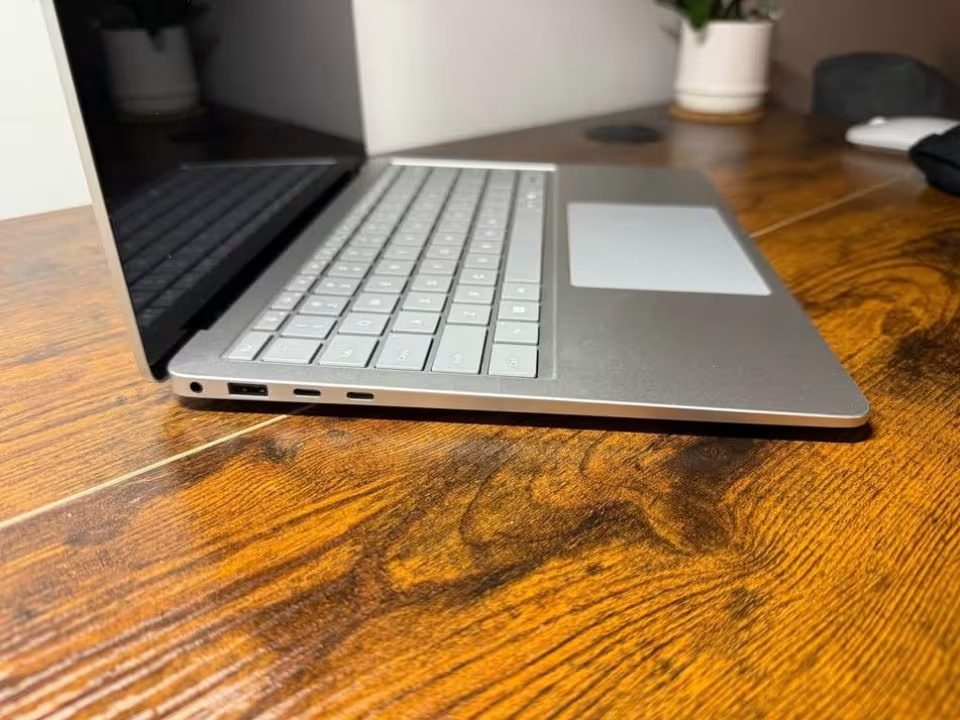
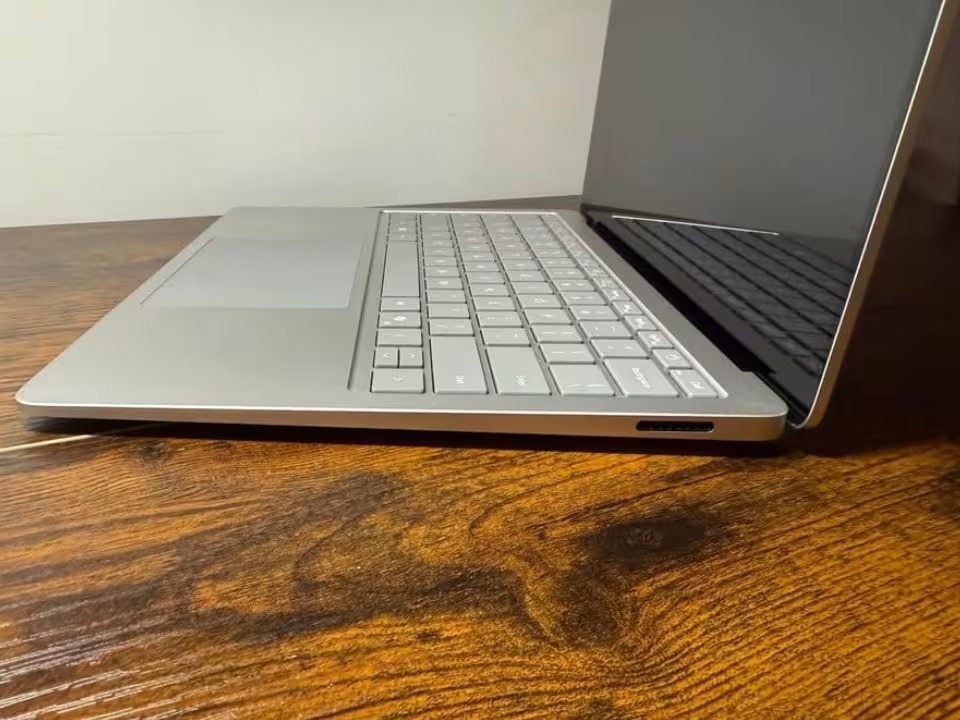
Intel i5 laptops usually have some more legacy ports that are useful to the users of older peripherals. An example of this is the Samsung Galaxy Book4 that has an RJ-45 LAN port to ensure a stable wired internet connexion.